Production, Purification and Characterization of Terpenes Isolated From Two New Strains of Yeasts in Iraq and Study of Their Antiparasitic Activity
DOI:
https://doi.org/10.48112/bcs.v2i1.392Abstract
 Abstract Views: 504
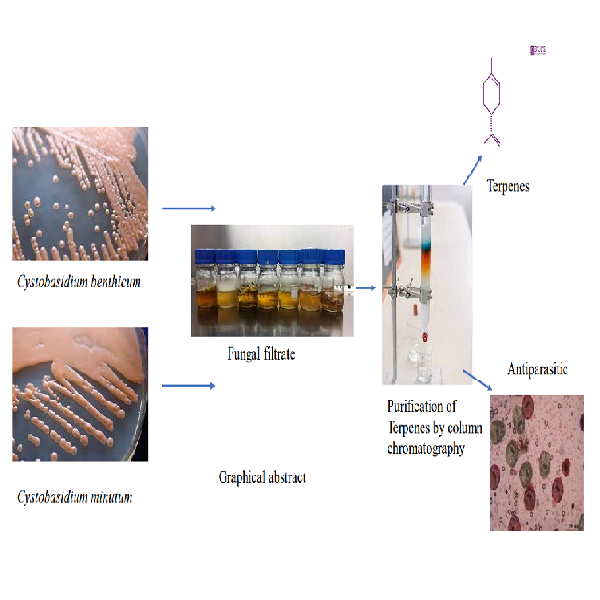
The current study was included isolation and identification of yeasts from five sediments soil samples from Al-Faw and Shatt al-Arab in Basrah provinces, Iraq. The soil samples were collected during fallow period 1-1-2021 to 1-6-2022. In the primary isolation dilution method used for cultured soil samples, two-crud colonies filtration was used. Two types of terpenes (T1, T2) were purified from culture filtrates of both species Cystobasidium benthicum and C .minutum separately. The thin layer chromatography and column chromatography were used in the first step of purification. Cytotoxicity test revealed no toxic effect for both terpenes at 0.2 gm / ml concentration. The two terpenes were identified using ultra violet and infra-red spectroscopy as well. Therefore, the results showed the terpenes nature of both toxins and determination of important active groups in the structure of the two isolated terpenes. The current study aimed to search for more treatments that limit the vitality of the larval stages of the parasite, so it was done antiparasite activity for both terpenes were performed against Echinococcus granulosus the results showed the T1 more activity against parasite compared with T2.
Keywords:
Antiparasitic, Fungal filtrates, New strains, Terpenes, UV and IR spectroscopy , IdentificationReferences
Abu-Mejdad, N. M. (2019). Isolation and molecular identification of yeasts, study their potential for producing killer toxins and evaluation of toxins activity against some bacteria and pathogenic fungi. Ph.D. thesis, 1-249.
Barabadi, H., Honary, S., Ali Mohammadi, M., Ahmadpour, E., Rahimi, M. T., Alizadeh, A., ... & Saravanan, M. (2017). Green chemical synthesis of gold nanoparticles by using Penicillium aculeatum and their scolicidal activity against hydatid cyst protoscolices of Echinococcus granulosus. Environmental Science and Pollution Research, 24(6), 5800-5810. https://doi.org/10.1007/s11356-016-8291-8
Fakhar, M., Chabra, A., Rahimi-Esboei, B., & Rezaei, F. (2015). In vitro protoscolicidal effects of fungal chitosan isolated from Penicillium waksmanii and Penicillium citrinum. Journal of Parasitic Diseases, 39(2), 162-167. https://doi.org/10.1007/s12639-013-0300-y
Harborne, J. (1984). Methods of plant analysis Phytochemical methods (pp. 1-36): Springer. https://doi.org/10.1007/978-94-009-5570-7_1
Jiang, M., Wu, Z., Guo, H., Liu, L., & Chen, S. (2020). A review of terpenes from marine-derived fungi: 2015–2019. Marine drugs, 18(6), 321. https://doi.org/10.3390/md18060321
Kuhnert, E., Surup, F., Wiebach, V., Bernecker, S., & Stadler, M. (2015). Botryane, noreudesmane and abietane terpenoids from the ascomycete Hypoxylon rickii. Phytochemistry, 117, 116-122. https://doi.org/10.1016/j.phytochem.2015.06.002
Kurtzman, C., Fell, J. W., & Boekhout, T. (2011). The yeasts: a taxonomic study: Elsevier.
Marrez, D. A., & Mohamad, H. S. (2020). Biological activity and applications of pyocyanin produced by Pseudomonas aeruginosa. Open Access Journal of Biomedical Science 2(1) https://dx.doi.org/10.38125/OAJBS.000133
Mirhendi, H., Makimura, K., Khoramizadeh, M., & Yamaguchi, H. (2006). A one-enzyme PCR-RFLP assay for identification of six medically important Candida species. Nippon Ishinkin Gakkai Zasshi, 47(3), 225-229. https://doi.org/10.3314/jjmm.47.225
Narsing Rao, M., Xiao, M., & Li, W. (2017). Fungal and bacterial pigments: secondary metabolites with wide applications. Frontiers in microbiology, 8, 1113. https://doi.org/10.3389/fmicb.2017.01113
Ntie-Kang, F., Njume, L. E., Malange, Y. I., Günther, S., Sippl, W., & Yong, J. N. (2016). The chemistry and biological activities of natural products from northern african plant families: From taccaceae to Zygophyllaceae. Natural products and bioprospecting, 6(2), 63-96. https://doi.org/10.1007/s13659-016-0091-9
Nurfitriyana, N., Fithri, N. A., & Yanuarti, R. (2022). ANALISIS INTERAKSI KIMIA FOURIER TRANSFORM INFRARED (FTIR) TABLET GASTRORENTIF EKSTRAK DAUN PETAI (Parkia speciosa Hassk) DENGAN POLIMER HPMC-K4M DAN KITOSAN. ISTA Online Technologi Journal, 3(2), 27-33. http://iontech.ista.ac.id/index.php/iontech/article/view/69
Shelor, C. P., Yoshikawa, K., & Dasgupta, P. K. (2021). Automated Programmable Generation of Broad pH Range Volatile Ionic Eluents for Liquid Chromatography. Analytical Chemistry, 93(13), 5442-5450. https://doi.org/10.1021/acs.analchem.0c05089
Wang, S., Xu, F., & Zhan, J. (2017). Introduction of natural pigments from microorganisms. Bio‐pigmentation and Biotechnological Implementations, 1-22. https://doi.org/10.1002/9781119166191.ch1

Downloads
Published
How to Cite
Issue
Section
License
Copyright (c) 2023 Biomedicine and Chemical Sciences

This work is licensed under a Creative Commons Attribution 4.0 International License.