Fungal Survey of Different Clinical Samples Collected from Patients
DOI:
https://doi.org/10.5281/zenodo.15771842Abstract
 Abstract Views: 194
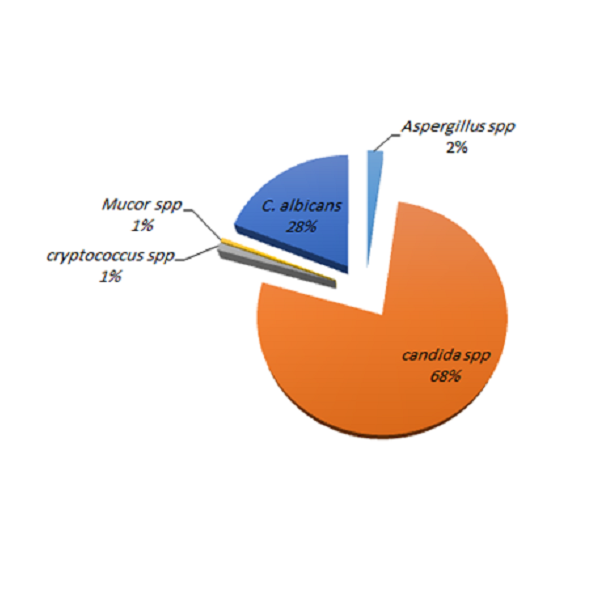
Candida is a genus of yeasts and is the most common cause of fungal infections worldwide. Candida spp., are eukaryotic representatives of the fungi kingdom. The genus Candida includes about 150 species, but many species are endosymbiosis of humans, causing infections mainly in immunosuppressed hosts. The frequency of Candida isolates as a cause of hospital infections has risen in recent years, leading to high rates of morbidity and mortality. The knowledge of the epidemiology of those hospital acquired fungal infections is essential to implement an adequate antifungal therapy. Fungal survey of different clinical samples collected from patients, to determine the effect of antifungal on C. albicans isolates from different body sites and lesions (blood, wounds swabs, ear swabs, bronchoalveolar lavage, high vaginal swabs, sputum, throat swabs, and urine). Swab sticks were collected from different sites of patients’ bodies (blood, wounds swabs, ear swabs, bronchoalveolar lavage, high vaginal swabs, sputum, throat swabs, and urine) then streaked directly on labelled Sabouraud's dextrose agar (SDA) plates and incubated at 25°C for (2-7) days. The growing colonies of Candida spp. isolates were initially diagnosed on (SDA) agar then confirmed by Chrome Candida Agar, the plates were incubated bunder aerobic conditions for 24 hr. at 37°C. Thereafter, antifungal sensitivity test was done. Only 209 of 1596 samples were taken from the patients and cultured on Sabouraud's dextrose agar were found to be positive. From 1596 just 59 isolate was Candida albicans after subculture on CROM Candida Agar, API candida and germ tube formation. Antifungal susceptibility tests were performed on 59 C. albicans isolates. Regarding antifungal resistance by C.albicans it was found 8 (14%) of isolates were resistant isolates resistant to fluconazole, 11 (19%) were resistant to miconazole as well as 11 (19%) were resistant to econazole, while 50 (85%) of isolates were sensitive to Nystatin, Clotrimazole (56, 95%), and to Ketoconazole (54, 92%). The study shows a higher antifungal resistance in the clinical samples which proves the risk in C. albicans management program.
Keywords:
Antifungal sensitivity test, C. albicans, Fungal surveyReferences
Agarwal, S. C. (2015). Emerging and emerged pathogenic Candida species: Beyond the Candida albicans paradigm. Journal of Patient Safety & Infection Control, 2(3), 63. https://doi.org/10.1371/journal.ppat.1003550
Al-mamari, A., Al-buryhi, M., Al-heggami, M. A., & Al-hag, S. (2014). Identify and sensitivity to antifungal drugs of Candida species causing vaginitis isolated from vulvovaginal infected patients in Sana’a city. Der PharmaChemica, 6(1), 336-342.
Alshehri, B. A., Rabaan, A. A., El-Masry, O. S., Acharya, S., Alzahrani, F. M., Al Mutair, A., & Al-Omari, A. (2022). A 20-year retrospective clinical analysis of Candida infections in tertiary centre: Single-center experience. Journal of Infection and Public Health, 15(1), 69-74.
Aryal, S. (2015). Germ Tube Test-Principle, Procedure, Results, Interpretation and Limitations.
Badiee, P., &Alborzi, A. (2011). Susceptibility of clinical Candida species isolates to antifungal agents by E-test, Southern Iran: A five year study. Iranian journal of microbiology, 3(4), 183.
Bihari, M., Srivastava, R., Jyoti, B., Mehrotra, V., Gupta, M., &Pradhan, S. (2014).Median rhomboid glossitis with palatal'kissing lesion'-A case report. Bangladesh Journal of Dental Research & Education, 4(2), 94-97.
Bitew, A., &Abebaw, Y. (2018).Vulvovaginal candidiasis: species distribution of Candida and their antifungal susceptibility pattern. BMC women's health, 18(1), 1-10. https://doi.org/10.1186/s12905-018-0607-z
Campbell, C. K., Davey, K. G., Holmes, A. D., Szekely, A., & Warnock, D. W. (1999). Comparison of the API Candida system with the AUXACOLOR system for identification of common yeast pathogens. Journal of clinical microbiology, 37(3), 821-823. https://doi.org/10.1128/jcm.37.3.821-823.1999
Carvalhinho, S., Costa, A. M., Coelho, A. C., Martins, E., &Sampaio, A. (2012). Susceptibilities of Candida albicans mouth isolates to antifungal agents, essentials oils and mouth rinses. Mycopathologia, 174, 69-76. https://doi.org/10.1007/s11046-012-9520-4
Chandra, Jyotsna, and Pranab K. Mukherjee. "Candida biofilms: development, architecture, and resistance." Microbiology spectrum 3.4 (2015): 3-4. https://doi.org/10.1128/9781555817466.ch6
Ciurea, C. N., Kosovski, I. B., Mare, A. D., Toma, F., Pintea-Simon, I. A., & Man, A. (2020). Candida and candidiasis—opportunism versus pathogenicity: a review of the virulence traits. Microorganisms, 8(6), 857. https://doi.org/10.3390/microorganisms8060857
Costa-de-Oliveira, S., & Rodrigues, A. G. (2020). Candida albicans antifungal resistance and tolerance in bloodstream infections: The triad yeast-host-antifungal. Microorganisms, 8(2),154. https://doi.org/10.3390/microorganisms8020154
Cui, X., Wang, L., Lü, Y., &Yue, C. (2022). Development and research progress of anti-drug resistant fungal drugs. Journal of Infection and Public Health. https://doi.org/10.1016/j.jiph.2022.08.004
Deravi, N., Fathi, M., Tabatabaeifar, S. N., Pooransari, P., Ahmadi, B., Shokoohi, G., & Ansari, S. (2021). Azole antifungal resistance in Candida albicans and Candida glabrata isolated from vulvovaginal candidiasis patients. Archives of Clinical Infectious Diseases, 16(2). https://doi.org/10.5812/archcid.106360
Du, H., Ennis, C. L., Hernday, A. D., Nobile, C. J., & Huang, G. (2020). N-Acetylglucosamine (GlcNAc) sensing, utilization, and functions in Candida albicans. Journal of Fungi, 6(3), 129. https://doi.org/10.3390/jof6030129
Gleiznys, A., Zdanavičienė, E., &Žilinskas, J. (2015).Candida albicans importance to denture wearers. A literature review. Stomatologija, 17(2), 54-66.
Gunasekera, Milan, et al. "Development of a Dual Path Platform (DPP®) immunoassay for rapid detection of Candida albicans in human whole blood and serum." Journal of Immunological Methods 424 (2015): 7-13. https://doi.org/10.1016/j.jim.2015.04.014
Holmes, A. R., Cannon, R. D., Shepherd, M. G., &Jenkinson, H. F. (1994).Detection of Candida albicans and other yeasts in blood by PCR. Journal of Clinical Microbiology, 32(1), 228-231. https://doi.org/10.1007/s00284-011-0064-5
Jacobsen, I. D., &Hube, B. (2017). Candida albicans morphology: still in focus. Expert Review of Anti-Infective Therapy, 15(4), 327-330. https://doi.org/10.1080/14787210.2017.1290524
Khadka, S., Sherchand, J. B., Pokhrel, B. M., Parajuli, K., Mishra, S. K., Sharma, S., ...&Rijal, B. P. (2017). Isolation, speciation and antifungal susceptibility testing of Candida isolates from various clinical specimens at a tertiary care hospital, Nepal. BMC research notes, 10(1), 1-5. http://dx.doi.org/10.1186/s13104-017-2547-3
Khan, M., Ahmed, J., Gul, A., Ikram, A., &Lalani, F. K. (2018).Antifungal susceptibility testing of vulvovaginal Candida species among women attending antenatal clinic in tertiary care hospitals of Peshawar. https://doi.org/10.2147/IDR.S153116
Kmeid, J., Jabbour, J. F., &Kanj, S. S. (2020). Epidemiology and burden of invasive fungal infections in the countries of the Arab League. Journal of infection and public health, 13(12), 2080-2086. https://doi.org/10.1016/j.jiph.2019.05.007
Koneman, E. W., Allen, S. D., Janda, W. M., Schreckenberger, P. C., & Winn, W. C. (1997). Diagnostic microbiology. The nonfermentative gram-negative bacilli.Philedelphia: Lippincott-Raven Publishers, 253-320.
Kraševec, N. (2022). The Multifaceted Role of Mating Type of the Fungus and Sex of the Host in Studies of Fungal Infections in Humans. Journal of Fungi, 8(5), 461. https://doi.org/10.3390/jof8050461
Lakhani, P., Patil, A., &Majumdar, S. (2019). Challenges in the polyene-and azole-based pharmacotherapy of ocular fungal infections. Journal of Ocular Pharmacology and Therapeutics, 35(1), 6-22. https://doi.org/10.1089/jop.2018.0089
Loster, J. E., Wieczorek, A., &Loster, B. W. (2016). Correlation between age and gender in Candida species infections of complete denture wearers: a retrospective analysis. Clinical interventions in aging, 1707-1714. https://doi/epdf/10.2147/CIA.S116658
Marak, M. B., &Dhanashree, B. (2018). Antifungal susceptibility and biofilm production of Candida spp. isolated from clinical samples. Int J Microbiol, 2018(7495218), 7495218. https://doi.org/10.1155/2018/7495218
Matare, T., Nziramasanga, P., Gwanzura, L., & Robertson, V. (2017). Experimental germ tube induction in Candida albicans: An evaluation of the effect of sodium bicarbonate on morphogenesis and comparison with pooled human serum. BioMed research international, 2017. https://doi.org/10.1155/2017/1976273
Monroy-Pérez, E., Paniagua-Contreras, G. L., Rodríguez-Purata, P., Vaca-Paniagua, F., Vázquez-Villaseñor, M., Díaz-Velásquez, C., ...&Vaca, S. (2016). High virulence and antifungal resistance in clinical strains of Candida albicans. Canadian Journal of Infectious Diseases and Medical Microbiology, 2016. http://dx.doi.org/10.1155/2016/5930489
Morgan, N. (2016). Cutaneous candidiasis. Wound Care Advisor, 5(5), 18-20.
Murray, M. P., Zinchuk, R., &Larone, D. H. (2005).CHROMagar Candida as the sole primary medium for isolation of yeasts and as a source medium for the rapid-assimilation-of-trehalose test. Journal of clinical microbiology, 43(3), 1210-1212. https://doi.org/10.1128/jcm.43.3.1210-1212.2005
Panizo, M. M., & Moreno, X. (2022). Laboratory Identification of Fungal Infections.
Sadeghi, G., Ebrahimi-Rad, M., Mousavi, S. F., Shams-Ghahfarokhi, M., &Razzaghi-Abyaneh, M. (2018). Emergence of non-Candida albicans species: epidemiology, phylogeny and fluconazole susceptibility profile. Journal de mycologiemedicale, 28(1), 51-58. https://doi.org/10.1016/j.mycmed.2017.12.008
Sardi, J. C. O., Scorzoni, L., Bernardi, T., Fusco-Almeida, A. M., & Mendes Giannini, M. J. S. (2013). Candida species: current epidemiology, pathogenicity, biofilm formation, natural antifungal products and new therapeutic options. Journal of medical microbiology, 62(1), 10-24 https://doi.org/10.1099/jmm.0.045054-0
She, X. D., Wang, X. J., Fu, M. H., Shen, Y. N., & Liu, W. D. (2008). Genotype comparisons of strains of Candida albicans from patients with cutaneous candidiasis and vaginal candidiasis. Chinese medical journal, 121(15), 1450-1455.
Singh, G., &Raksha, A. U. (2013).Candidal infection: epidemiology, pathogenesis and recent advances for diagnosis. Bulletin of Pharmaceutical and Medical Sciences (BOPAMS), 1(1), 1-8.
Terças, A. L., Marques, S. G., Moffa, E. B., Alves, M. B., de Azevedo, C. M., Siqueira, W. L., &Monteiro, C. A. (2017). Antifungal drug susceptibility of Candida species isolated from HIV-positive patients recruited at a public hospital in São Luís, Maranhão, Brazil. Frontiers in microbiology, 8, 298. https://doi.org/10.3389/fmicb.2017.00298
Uthayakumar, D., Sharma, J., Wensing, L., & Shapiro, R. S. (2021). CRISPR-based genetic manipulation of Candida species: historical perspectives and current approaches. Frontiers in Genome Editing, 2, 606281. https://doi.org/10.3389/fgeed.2020.606281
Wang, X., He, H., Liu, J., Xie, S., & Han, J. (2020).Inhibiting roles of farnesol and HOG in morphological switching of Candida albicans. American Journal of Translational Research, 12(11), 6988.
Williams, R. B., & Lorenz, M. C. (2020). Multiple alternative carbon pathways combine to promote Candida albicans stress resistance, immune interactions, and virulence. MBio, 11(1), e03070-19. https://doi.org/10.1128/mbio.03070-19
Zaidi, K. U., Mani, A., Parmar, R., &Thawani, V. (2018).Antifungal susceptibility pattern of Candida albicans in human infections. Open Biological Sciences Journal, 4(1). http://dx.doi.org/10.2174/2352633501804010001
Zehm, Sarah, et al. "Detection of Candida albicans by mass spectrometric fingerprinting." Current microbiology 64.3 (2012): 271-275.

Downloads
Published
How to Cite
Issue
Section
License
Copyright (c) 2024 Biomedicine and Chemical Sciences

This work is licensed under a Creative Commons Attribution 4.0 International License.