Conventional Versus Molecular Methods for Diagnosis of Burkholderia cepacia from Different Clinical Samples of Iraqi Patients
DOI:
https://doi.org/10.48112/bcs.v1i2.94Abstract
 Abstract Views: 572
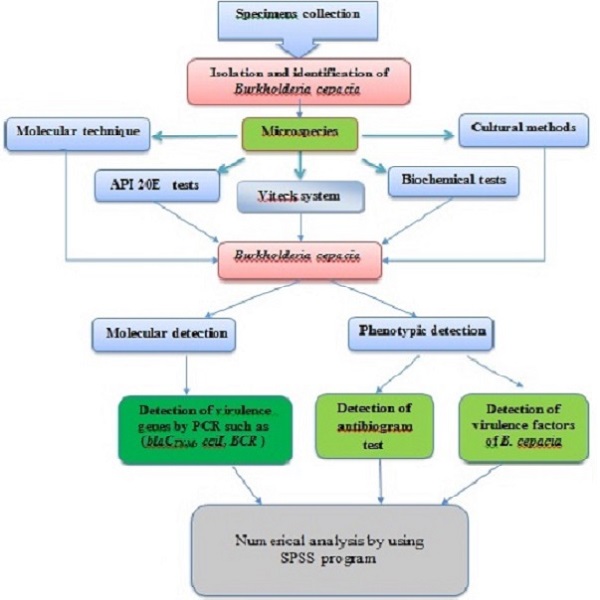
The study aims at isolating and identification of Burkholderia cepacia bacteria from clinical samples from various pathological conditions such as diabetic foot ulcers, burn, wound, sputum and urine. The present study includes 280 samples collected from patients suffering from diabetic foot ulcer, cystic fibrosis, burns, sputum, and wounds who attend Alsader Medical City and Al-Hakim General Hospital during the period extended from September 2020 to February 2021 ( men and women ) with age groups between (1 -75) years. The identification of bacterial isolates were detected by classical and molecular technique (PCR), where the frequency among males 213 (79.2%) was more than that in female 67 (20.8%). The samples distribution is made according to age group; it appears high for the following high 26.8% with group (31-45) years male and female; 22% with group (31-45) years in male and 7.6% with the group (1-15) years in female. The results revealed that 42/80 specimens of the total number of samples are Burkholderia cepacia by using 16SrRNA gene to differentiate the B. cepacia from other (G-) bacteria, and 30/80 recA gene to differentiated B. cepacia from B. cepacia complex.
Keywords:
B. cepacia, API 20E, Vitek, PCRReferences
ALmuhana, M. R, and Al-Ammar, M. H. (2020). Phenotypic and Genotypic Detection of Multidrug Resistane of Pseudomonas aeruginosa and Burkholderia cepecia Isolated from Patients with Diabetes Foot Ulcer in Al Najaf Province . Thesis, the Faculty of Science, University of Kufa.
Al-Sadi, A. M., Al-Oweisi, F. A., Edwards, S. G., Al-Nadabi, H., & Al-Fahdi, A. M. (2015). Genetic analysis reveals diversity and genetic relationship among Trichoderma isolates from potting media, cultivated soil and uncultivated soil. BMC microbiology, 15(1), 1-11. https://doi.org/10.1186/s12866-015-0483-8
Al-Sadi, A. M., Al-Oweisi, F. A., Edwards, S. G., Al-Nadabi, H., & Al-Fahdi, A. M. (2015). Genetic analysis reveals diversity and genetic relationship among Trichoderma isolates from potting media, cultivated soil and uncultivated soil. BMC microbiology, 15(1), 1-11. https://doi.org/10.1186/s12866-015-0483-8
Bernier, S. P., Silo-Suh, L., Woods, D. E., Ohman, D. E., & Sokol, P. A. (2003). Comparative analysis of plant and animal models for characterization of Burkholderia cepacia virulence. Infection and immunity, 71(9), 5306-5313. https://doi.org/10.1128/IAI.71.9.5306-5313.2003
Cheesbrough, M. (2005). District laboratory practice in tropical countries, part 2. Cambridge university press.
Farzana, R., Jones, L. S., Rahman, M. A., Sands, K., Portal, E., Boostrom, I., ... & Walsh, T. R. (2020). Molecular and epidemiological analysis of a Burkholderia cepacia sepsis outbreak from a tertiary care hospital in Bangladesh. PLoS neglected tropical diseases, 14(4), e0008200. https://doi.org/10.1371/journal.pntd.0008200
Hasan, A. S. (2019). Antibiogram of Pseudomonas aeruginosa Isolated from Burn& Wound Infections Among Inpatients and Outpatients Attending to Ramadi Teaching Hospital in Ramadi, Iraq. Egyptian Academic Journal of Biological Sciences, G. Microbiology, 11(1), 13-22.
Jung, B. K., Hong, S. J., Park, G. S., Kim, M. C., & Shin, J. H. (2018). Isolation of Burkholderia cepacia JBK9 with plant growth-promoting activity while producing pyrrolnitrin antagonistic to plant fungal diseases. Applied Biological Chemistry, 61(2), 173-180. https://doi.org/10.1007/s13765-018-0345-9
Martina, P. F., Martinez, M., Rivas, S., Leguizamón, L., Specht, M. V., & Ferreras, J. (2020). Burkholderia cepacia complex: 11 years of surveillance in patients with Cystic Fibrosis in Posadas, Argentina. Revista argentina de microbiología, 52(3), 21-30.
Miller, S. C., LiPuma, J. J., & Parke, J. L. (2002). Culture-based and non-growth-dependent detection of the Burkholderia cepacia complex in soil environments. Applied and Environmental Microbiology, 68(8), 3750-3758. https://doi.org/10.1128/AEM.68.8.3750-3758.2002
Payne, G. W., Vandamme, P., Morgan, S. H., LiPuma, J. J., Coenye, T., Weightman, A. J., ... & Mahenthiralingam, E. (2005). Development of a recA gene-based identification approach for the entire Burkholderia genus. Applied and environmental microbiology, 71(7), 3917-3927. https://doi.org/10.1128/AEM.71.7.3917-3927.2005
Ranjan, R., Chowdhary, P., & Kamra, A. (2017). Community Acquired Burkholderia cepacia Bacteraemia Presenting as MODS in an Immunocompetent Individual: An Unusual Case. Journal of Clinical & Diagnostic Research, 11(3). https://dx.doi.org/10.7860/JCDR/2017/16285.9435
Safdar, A. (2015). Stenotrophomonas maltophilia and Burkholderia cepacia. Mandell, Douglas, and Bennett's Principles and Practice of Infectious Diseases” (Eighth Edition), Volume 2, pp. 2532-2540.e4. https://doi.org/10.1016/B978-1-4557-4801-3.00222-8
Sapkota, S., Ganesan, S. K., Priyadarshini, M., Tripathi, P., Savitha, S., & Bhattacharjee, S. (2018). Clinical Spectrum of Burkholderia cepacia Infection in Cancer Patients: A Retrospective Study of an Emerging Disease. Med Microbiol Rep 2, 1, 2.
Stopnisek, N., Zühlke, D., Carlier, A., Barberán, A., Fierer, N., Becher, D., ... & Weisskopf, L. (2016). Molecular mechanisms underlying the close association between soil Burkholderia and fungi. The ISME journal, 10(1), 253-264. https://doi.org/10.1038/ismej.2015.73
Tavares, M., Kozak, M., Balola, A., & Sá-Correia, I. (2020). Burkholderia cepacia Complex Bacteria: a Feared Contamination Risk in Water-Based Pharmaceutical Products. Clinical Microbiology Reviews, 33(3). https://journals.asm.org/doi/10.1128/CMR.00139-19
Verma, P., Yadav, A. N., Khannam, K. S., Mishra, S., Kumar, S., Saxena, A. K., & Suman, A. (2019). Appraisal of diversity and functional attributes of thermotolerant wheat associated bacteria from the peninsular zone of India. Saudi journal of biological sciences, 26(7), 1882-1895. https://doi.org/10.1016/j.sjbs.2016.01.042
Woo, P. C. Y., Lau, S. K. P., Teng, J. L. L., Tse, H., & Yuen, K. Y. (2008). Then and now: use of 16S rDNA gene sequencing for bacterial identification and discovery of novel bacteria in clinical microbiology laboratories. Clinical Microbiology and Infection, 14(10), 908-934. https://doi.org/10.1111/j.1469-0691.2008.02070.x
Xu, Y., Buss, E. A., & Boucias, D. G. (2016). Culturing and characterization of gut symbiont Burkholderia spp. from the southern chinch bug, Blissus insularis (Hemiptera: Blissidae). Applied and environmental microbiology, 82(11), 3319-3330. https://doi.org/10.1128/AEM.00367-16

Downloads
Published
How to Cite
Issue
Section
License
Copyright (c) 2022 Biomedicine and Chemical Sciences

This work is licensed under a Creative Commons Attribution 4.0 International License.