Magnitude of Perinatal Mortality and Associated Factors among Babies born in Hospital Vadodara, Gujarat
DOI:
https://doi.org/10.5281/zenodo.15773060Abstract
 Abstract Views: 186
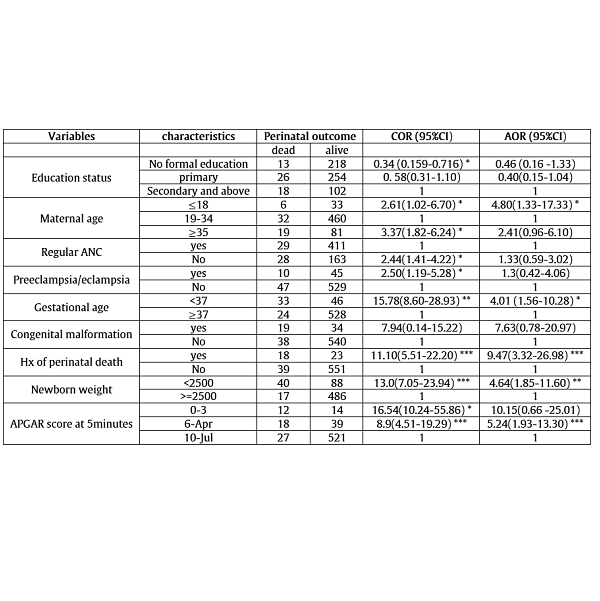
Perinatal mortality is defined as both stillbirth and early neonatal deaths which occurs from 28 gestational age of pregnancy for seven completed days after birth or at least one kilogram. Perinatal mortality is a health indicator for prenatal, intra partum and newborn care. It is one of the major challenges for under-five mortality. Up to the knowledge of principal investigator while searching different literatures, there is a limited number of studies have related to perinatal deaths in our country. Most of the researchers have used secondary data. Therefore; this study may fill this gap by assessing the magnitude of perinatal mortality and associated factors among babies born based on the primary data. Institutional based cross sectional study design was conducted among 631study participants. Epi-data 4.2 and SPSS Version 21 was used for data entry and analysis respectively. The variable associated with the outcome variable in Bivariate p value <0.25 was considered for further multivariable analysis to control for potential confounding. Crude and Adjusted Odd Ratios was calculated to assess the association between dependent and independent variable with 95% CI. The variable which shows p ≤0.05 was considered as statistically significance. The magnitude of perinatal, mortality was found to be 9.0% (95%, CI: 7%-11%). Maternal age less than 18 years (AOR, 4.80CI; 1.33-17.33), history of perinatal loss (AOR 9.47, CI:3.32-26.98), gestational age less than 37weeks (AOR,4.01 CI:1.56-10.28), Apgar score (4-6) (AOR,5.24, CI:1.93-13.30) and low birth weight (AOR, 4.64CI:1.85-11.60) was significantly associated with perinatal mortality. Generally, this study has high perinatal death, which needs more attention. Maternal age less than 18 years, gestational age less than 37 wks, low birth weight, history of perinatal loss and (4-6) Apgar score at 5 minutes were significant predictors of perinatal death.
Keywords:
Early neonatal deaths, Hospital Vadodara, Intra partum, Newborn care, Perinatal mortalityReferences
Ahmed, M. A., Duncan, M., Kent, A., & NICUS Group. (2006). Incidence of retinopathy of prematurity requiring treatment in infants born greater than 30 weeks’ gestation and with a birthweight greater than 1250 g from 1998 to 2002: A regional study. Journal of Paediatrics and Child Health, 42(6), 337-340. https://doi.org/10.1111/j.1440-1754.2006.00868.x
Allanson, E. R., Muller, M., & Pattinson, R. C. (2015). Causes of perinatal mortality and associated maternal complications in a South African province: challenges in predicting poor outcomes. BMC Pregnancy and Childbirth, 15, 1-7. https://doi.org/10.1186/s12884-015-0472-9
Alves, S. A., Cavalcante, E. V., Melo, N. T., Lima, A. C., e Silva, E. J., de Lima, G. M., ... & Alves, J. G. (2020). Fat distribution among children born extremely low birth weight and very low birth weight: a cohort study. Childhood Obesity, 16(8), 549-553. https://doi.org/10.1089/chi.2020.0186
Andarge, E., Nigussie, A., & Wondafrash, M. (2017). Factors associated with birth preparedness and complication readiness in Southern Ethiopia: a community based cross-sectional study. BMC Pregnancy and Childbirth, 17, 1-13. https://doi.org/10.1186/s12884-017-1582-3
Baskett, T. F. (2000). Virginia Apgar and the newborn Apgar score. Resuscitation, 47(3), 215-217.
Bayou, G., & Berhan, Y. (2012). Perinatal mortality and associated risk factors: a case control study. Ethiopian Journal of Health Sciences, 22(3).
Kahane, A. F., Park, A. L., & Ray, J. G. (2018). Newborn Apgar score and prediction of maternal death. Epidemiology, 29(4), e27-e29. https://doi.org/10.1097/EDE.0000000000000852
McPherson, E., Nestoridi, E., Heinke, D., Roberts, D. J., Fretts, R., Yazdy, M. M., & Lin, A. E. (2017). Alternatives to autopsy for fetal and early neonatal (perinatal) deaths: insights from the Wisconsin stillbirth service program. Birth Defects Research, 109(18), 1430-1441. https://doi.org/10.1002/bdr2.1112
Mohangoo, A. D., Blondel, B., Gissler, M., Velebil, P., Macfarlane, A., Zeitlin, J., & Euro-Peristat Scientific Committee. (2013). International comparisons of fetal and neonatal mortality rates in high-income countries: should exclusion thresholds be based on birth weight or gestational age?. PloS one, 8(5), e64869. https://doi.org/10.1371/journal.pone.0064869
Mpembeni, R., Jonathan, R., & Mughamba, J. (2014). Perinatal mortality and associated factors among deliveries in three municipal hospitals of Dar Es Salaam. Tanzania. J Pediatric Neonatal Care, 1(4), 1-7.
Nguyen, T. M., & Castro, L. C. (2019). Hypertensive disorders and depression in pregnancy: pregnancy complications and fetal versus neonatal outcomes. Journal of Women's Health, 28(11), 1451-1453. https://doi.org/10.1089/jwh.2019.8107
Onrust, S., Santema, J. G., & Aarnoudse, J. G. (1999). Pre-eclampsia and the HELLP syndrome still cause maternal mortality in the Netherlands and other developed countries; can we reduce it?. European Journal of Obstetrics & Gynecology and Reproductive Biology, 82(1), 41-46. https://doi.org/10.1016/S0301-2115(98)00208-5Belachew, A., Tewabe, T., & Dessie, G. (2022). Neonatal mortality and its association with antenatal care visits among live births in Ethiopia: a systematic review and meta-analysis. The Journal of Maternal-Fetal & Neonatal Medicine, 35(2), 348-355. https://doi.org/10.1080/14767058.2020.1718093
Seppa, N. (2013). Body & brain: Home births more risky than hospital deliveries: Records suggest babies born at home are more prone to unresponsiveness after five minutes. Science News, 184(8),14-14. https://doi.org/10.1002/scin.5591840813
Tamang, S. T., Dorji, T., Yoezer, S., Phuntsho, T., & Dorji, P. (2021). Knowledge and understanding of obstetric danger signs among pregnant women attending the antenatal clinic at the National Referral Hospital in Thimphu, Bhutan: a cross-sectional study. BMC Pregnancy and Childbirth, 21, 1-9. https://doi.org/10.1186/s12884-021-03580-4
Wall, S. N., Lee, A. C., Niermeyer, S., English, M., Keenan, W. J., Carlo, W., ... & Lawn, J. E. (2009). Neonatal resuscitation in low-resource settings: what, who, and how to overcome challenges to scale up?. International Journal of Gynecology & Obstetrics, 107, S47-S64. https://doi.org/10.1016/j.ijgo.2009.07.013

Downloads
Published
How to Cite
Issue
Section
License
Copyright (c) 2024 Biomedicine and Chemical Sciences

This work is licensed under a Creative Commons Attribution 4.0 International License.