Risk Factors Associated with Urinary Schistosomiasis and Its Spatial Distribution Among Almajirai in Selected Localities in Katsina State, Nigeria
DOI:
https://doi.org/10.5281/zenodo.15773360Abstract
 Abstract Views: 167
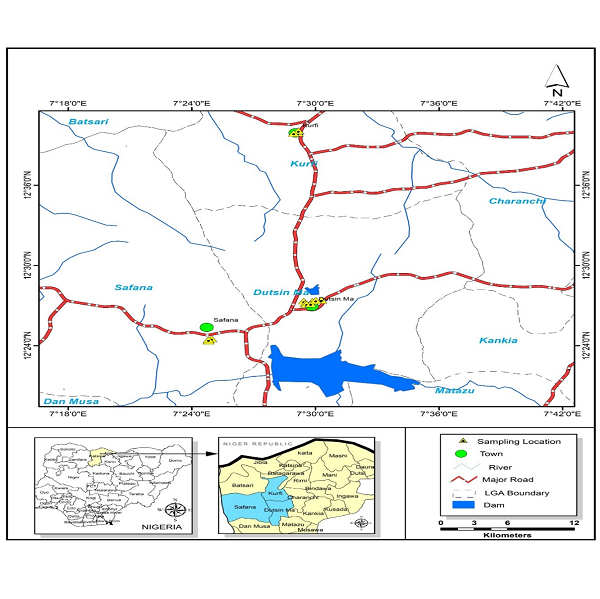
Urinary schistosomiasis is a chronic neglected tropical disease (NTD), which is endemic in Nigeria, and is largely attributable to poverty. This study sought to determine the risk factors associated with urinary schistosomiasis and its spatial distribution in Safana, Dutsin-Ma, and Kurfi towns of Katsina State, Nigeria. Urine samples were collected from thirteen Tsangaya schools between 1st June and 30th September 2023, the participants’ samples and socio-demographic data were analyzed for the ova of Schistosoma haematobium and associated risk factors using the centrifugation technique and Chi-square tests, respectively. Out of the 514 samples examined, 35.6% were positive for the ova of S. haematobium. The predisposing risk factors for the infection included; contact with large water bodies (ꭓ = 0.2060, P=0.6500), and age group (ꭓ =50.6220, P=0.0000). Participants with haematuria recorded a higher prevalence (49.7%) than those with no haematuria (17.1%), and the infection was significantly associated with haematuria (ꭓ = 58.2460, P= 0.0000). The source of water, contact with water bodies, age group, and lack of a history of praziquantel treatment were identified as risk factors for the infection. To prevent continuous transmission of the disease, the study recommends improved environmental sanitation and regular mass deworming of Almajirai.
Keywords:
Dutsin-Ma, Kurfi, Neglected tropical diseases, Tsangaya school, Urinary bilharziasis, Vulnerable childrenReferences
Amuta, E. U., & Houmsou, R. S. (2014). Prevalence, intensity of infection and risk factors of urinary schistosomiasis in pre-school and school-aged children in Guma Local Government Area, Nigeria. Asian Pacific Journal of Tropical Medicine, 7(1), 34-39. https://doi.org/10.1016/S1995-7645(13)60188-1
Amzat, J. (2001). Lumpen childhood in Nigeria: A case of the Almajirai in Northern Nigeria. Islamic Culture, 85(3), 85-103. https://doi.org/10.13140/RG.2.1.2480.1444
Atalabi, T. E., Lawal, U., & Ipinlaye, S. J. (2016). Prevalence and intensity of genito-urinary schistosomiasis and associated risk factors among junior high school students in two local government areas around Zobe Dam in Katsina State, Nigeria. Parasites & Vectors, 9(1), 1-12. https://doi.org/10.1186/s13071-016-1672-5
Auta, T., Ezra, J. J., Rufai, H. S., Alabi, E. D., & Anthony, E. (2020). Urinary Schistosomiasis among Vulnerable Children in Security Challenged District of Safana, Katsina State-Nigeria. International Journal of Tropical Disease & Health, 41(23), 73-81. https://doi.org/10.9734/IJTDH/2020/v41i2330419
Bamgbola, O. F. (2014). Urinary schistosomiasis. Pediatric Nephrology, 29, 2113-2120. https://doi.org/10.1007/s00467-013-2723-1
Butterworth, A. E., Curry, A. J., Dunne, D. W., Fulford, A. J., Kimani, G., Kariuki, H. C., ... & Ouma, J. H. (1994). Immunity and morbidity in human schistosomiasis mansoni. Tropical and Geographical Medicine, 46(4 Spec No), 197-208. PMID: 7825222.
Barsoum, R. S. (2013). Urinary schistosomiasis. Journal of Advanced Research, 4(5), 453-459. https://doi.org/10.1016/j.jare.2012.08.004
Cheesbrough, M. (2005). District laboratory practice in tropical countries. 2nd Edition, (part one), Cambridge University Press: New York, 236– 239.
Gamde, S., Garba, A., Tongvwam, P., Gamde, S., Agom, D., & Igbinosa, I. (2023). Prevalence, intensity, and risk factors of urinary schistosomiasis among primary school children in Silame, Sokoto, Nigeria. Microbes and Infectious Diseases, 4(2), 695-703. https://doi.org/10.21608/mid.2022.155035.1365
Golan, R., Gower, C. M., Emery, A. M., Rollinson, D., & Webster, J. P. (2008). Isolation and characterization of the first polymorphic microsatellite markers for Schistosoma haematobium and their application in multiplex reactions of larval stages. Molecular Ecology Resources, 8(3), 647-649. https://doi.org/10.1111/j.1471-8286.2007.02031.x
Knopp, S., Ame, S. M., Hattendorf, J., Ali, S. M., Khamis, I. S., Bakar, F., & Rollinson, D. (2018). Urogenital schistosomiasis elimination in Zanzibar: accuracy of urine filtration and haematuria reagent strips for diagnosing light intensity Schistosoma haematobium infections. Parasites & Vectors, 11(1), 1-11. https://doi.org/10.1186/s13071-018-3136-6.
Mashema, B. L., Idria, A. I., & Musa, Y. (2018). The challenges of almajiri system of education to social peace in Nigeria: a cross-sectional investigation. International Journal of Innovative Research and Advanced Studies (IJIRAS), 5, 8:44-50.
Toor, J., Alsallaq, R., Truscott, J. E., Turner, H. C., Werkman, M., Gurarie, D., & Anderson, R. M. (2018). Are we on our way to achieving the 2020 goals for schistosomiasis morbidity control using current World Health Organization guidelines? Clinical Infectious Diseases, 66(suppl_4), S245-S252. https://doi.org/10.1093/cid/ciy001
World Health Organization (2016). Global health estimates 2016: Deaths by cause, age, sex, by country and by region, 2000-2016. Geneva, Switzerland: World Health Organization; 2018.

Downloads
Published
How to Cite
Issue
Section
License
Copyright (c) 2024 Biomedicine and Chemical Sciences

This work is licensed under a Creative Commons Attribution 4.0 International License.