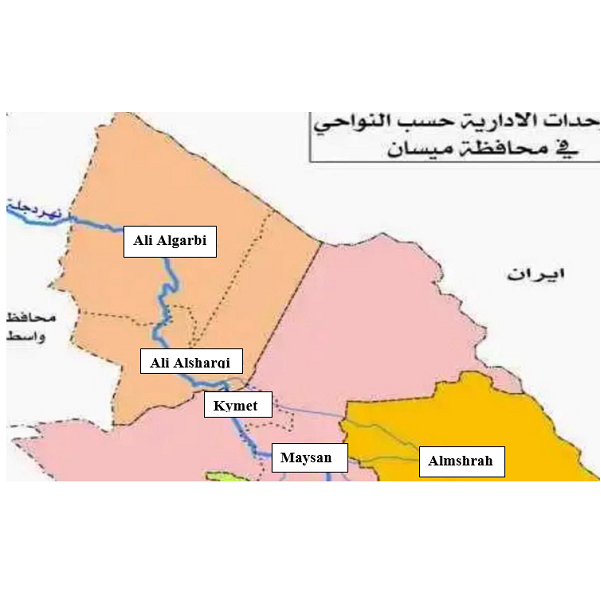
The Quantity of Uranium in Soil Samples Collected from Particular Sites Within the North Maysan Governorate Using ICP-MS
DOI:
https://doi.org/10.5281/zenodo.15288406Abstract
 Abstract Views: 235
In this particular investigation, 30 surface soil samples taken from various locations across North Maysan governorate were analyzed using ICP-MS (inductively coupled plasma mass spectrometry), several of which the researchers know, have been analyzed for an initial time. Uranium was investigated in soils in concentrations ranging from 0.52 µg.mL-1 (Almajar Alkabeer 4) to 1.91 µg.mL-1 (Almajar Alkabeer5). The results are presented and compared with the ones from a different study. The soil samples that were studied had less than 100 µg.mL-1 of uranium, which shows that they are composed of overloads and garbage rather than mineable stocks. This article describes and assesses the uranium content in the North Maysan Governorates. Additionally, all 30 exposed earth samples had uranium below the detection threshold. The results show that the samples of surface soils under investigation have uranium concentrations below the allowable limit (11.7 µg.mL-1) established by UNSCEAR in 1993.
Keywords:
ICP-MS, North Maysan governorate, Quantity of uranium, Soil samplesReferences
Akram, M., Nazar, M., Ghaffar, A., Malik, F., Ali, N., Mujahid, S. A., & Rajput, M. U. (2013). Neutron induced fission track estimation of uranium concentration and its associated health hazards in drinking water of the Faisalabad Industrial City. World Journal of Nuclear Science and Technology, 3(2), 51-58.
Algrifi, M. A., & Salman, T. M. (2023). Measuring uranium concentration in Um Qasr district, southern Iraq, in two different ways. Applied Radiation and Isotopes, 192, 110595. https://doi.org/10.1016/j.apradiso.2022.110595
Alyaa, A., & Asia, H. (2015). Measuring the uranium concentration for adults teeth in Al-Fluja city using nuclear track detector (CR-39). Journal of Current Engineering and Technology, 5(6).
Gavrilescu, M., Pavel, L. V., & Cretescu, I. (2009). Characterization and remediation of soils contaminated with uranium. Journal of hazardous materials, 163(2-3), 475-510. https://doi.org/10.1016/j.jhazmat.2008.07.103
Hashim, A. K., & Najam, L. A. (2015). Radium and uranium concentrations measurements in vegetables samples of Iraq. Detection, 3(04), 21. https://doi.org/10.4236/detection.2015.34004
Keith, S., Faroon, O., Roney, N., Scinicariello, F., Wilbur, S., Ingerman, L., ... & Diamond, G. (2013). Toxicological Profile for Uranium. Agency for Toxic Substances and Disease Registry (US), Atlanta (GA). https://doi.org/10.15620/cdc:95222
Nidhala H. K. Al-Ani, Qasim, R. Y. and Abd- Al-Hussein Z. , Journal of Baghdad for Science, (2011), 8, 1, 39 – 43. https://doi.org/10.21123/bsj.2011.8.1.39-43
Salman, T. M., & Algrifi, M. A. (2022). Measurement of Uranium Concentration in Basrah Soils Using the CR-39 Detector. Biomedicine and Chemical Sciences, 1(3), 164-167. https://doi.org/10.48112/bcs.v1i3.174
Salman, T. M., & Algrifi, M. A. (2022). Using the ICP-MS method, the concentration of uranium in soil samples from the Northern Basrah governorate was determined. Al-Bahir Journal for Engineering and Pure Sciences, 1(1), 1.
Salman, T. M., & Fleifil, S. S. (2015). Evaluation of uranium concentration in soil samples of Basrah Governorates using ICP-mass techniques. Evaluation, 5(10), 43e7.
United Nations Scientific Committee on the Effects of Atomic Radiation. (2022). Sources, Effects and Risks of Ionizing Radiation, United Nations Scientific Committee on the Effects of Atomic Radiation (UNSCEAR) 2020/2021 Report, Volume IV: Scientific Annex D-Evaluation of Occupational Exposure to Ionizing Radiation. United Nations. https://doi.org/10.18356/55345362-en
United Nations Scientific Committee on the Effects of Atomic Radiation. (1982). Ionizing radiation: Sources and biological effects. 1982 report to the general assembly, with annexes. https://doi.org/10.18356/a71e0e29-en
Yousuf, R. M., & Abullah, K. O. (2011). Measurement of uranium and radon Concentrations in resources of water from Sulaimany Governorate-Kurdistan region-iraq. ARPN Journal of Science and Technology, 3(6), 632-638.

Downloads
Published
How to Cite
Issue
Section
License
Copyright (c) 2023 Biomedicine and Chemical Sciences

This work is licensed under a Creative Commons Attribution 4.0 International License.