Assessment of Molecular Heterogeneity of Beta-Thalassemia in Population of Karak
DOI:
https://doi.org/10.5281/zenodo.15773701Abstract
 Abstract Views: 285
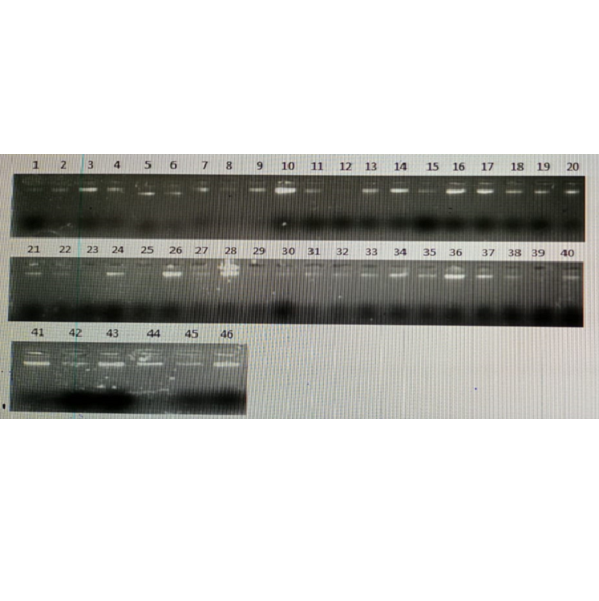
This study was designed to assess the distribution and genetic mutations of beta thalassemia in HBB gene across the district Karak. The DNA was extracted from the collected samples and gene specific point mutation was assessed using ARMS-PCR. The analysis showed the homozygosity or heterozygosity of the specific mutations (IVSI-5, CD 41-42, FSC 8-9 and CAP +15). Appropriate statistical method was used to differentiate the point mutation which is distributed in the people. Dendrogram analysis revealed variations among the studied cases. A total of three clusters were observed containing all the 46 samples (patients) based on the Euclidian distance (ranged 0-37). C-III was the biggest of all cluster as it was having 17 (36.96%) out of 46 samples while C-I and C-II was having 14 (30.43%) and 15 (32.61%) samples, respectively. Profile plot was also constructed on samples to observe the variation of each marker across all the population. It was revealed that marker IVS1-5 have values 2.3, 1.7 and 1.1 in clusters C-I, C-II and C-III respectively. Primer CD 41-42 showed values of 1.4, 2.8 and 1.2, primer FSC 8-9 had values of 1.6, 1.7 and 1.9, marker CAP 1-5 had values 2.4, 1.5 and 1.2 for C-I, C-II and C-III, respectively. Overall, the most prevalent mutation identified in this study was IVSI-5, FSC 8-9, CAP +15 and CD 41-42. It was also noted that most of the patient’s parents were not first cousin, 50% patients’ parents were second cousins. Moreover, it was observed that not proper diagnostic centers or genetic counseling centers are available at district Karak. Hence, if the government and non-governmental organizations play their role in establishment of proper pre-natal and genetic counseling centers the disease burden of the area can be minimized.
Keywords:
Beta-thalassemia, Genetic mutations, Molecular heterogeneity, Population of KarakReferences
Ahmed, S., Saleem, M., Modell, B., & Petrou, M. (2002). Screening extended families for genetic hemoglobin disorders in Pakistan. New England Journal of Medicine, 347(15), 1162-1168. https://doi.org/10.1056/NEJMsa013234
Ali, T. T., David, J. W., & Maria, D. C. (2018). Thalassaemia [J]. Lancet, 391, 155-67.
Bittles, A. H., & Black, M. L. (2010). Consanguinity, human evolution, and complex diseases. Proceedings of the National Academy of Sciences, 107(suppl_1), 1779-1786. https://doi.org/10.1073/pnas.0906079106
Cai, L., Bai, H., Mahairaki, V., Gao, Y., He, C., Wen, Y., ... & Cheng, L. (2018). A universal approach to correct various HBB gene mutations in human stem cells for gene therapy of beta-thalassemia and sickle cell disease. Stem Cells Translational Medicine, 7(1), 87-97. https://doi.org/10.1002/sctm.17-0066
Chan, O. T., Westover, K. D., Dietz, L., Zehnder, J. L., & Schrijver, I. (2010). Comprehensive and efficient HBB mutation analysis for detection of β-hemoglobinopathies in a pan-ethnic population. American Journal of Clinical Pathology, 133(5), 700-707. https://doi.org/10.1309/AJCP7HQ2KWGHECIO
Christianson, J. C., & Green, W. N. (2004). Regulation of nicotinic receptor expression by the ubiquitin–proteasome system. The EMBO journal, 23(21), 4156-4165. https://doi.org/10.1038/sj.emboj.7600436
Collins, F. S., & Weissman, S. M. (1984). The molecular genetics of human hemoglobin. Progress in Nucleic Acid Research and Molecular Biology, 31, 315-465. https://doi.org/10.1016/S0079-6603(08)60382-7
Galanello, R., & Origa, R. (2012). Beta-thalassemia: Orphanet j rare dis. Journal of Continuing Education Topics & Issues, 14(1), 33-34.
Higgs, D. R., & Weatherall, D. J. (2009). The alpha thalassaemias. Cellular and Molecular Life Sciences, 66, 1154-1162. https://doi.org/10.1007/s00018-008-8529-9
Jalil, T., Yousafzai, Y. M., Rashid, I., Ahmed, S., Ali, A., Fatima, S., & Ahmed, J. (2019). Mutational Analysis Of Beta Thalassaemia By Multiplex Arms-Pcr In Khyber Pakhtunkhwa, Pakistan. Journal of Ayub Medical College Abbottabad-Pakistan, 31(1).
Khan, N. M., Rehman, S. U., Shakeel, M., Khan, S., Ahmed, U., Rehman, H., ... & Javid, A. (2018). Molecular characterization of β-thalassemia mutations via the amplification refractory mutation system-polymerase chain reaction method at the North Waziristan Agency, Pakistan. Hemoglobin, 42(2), 91-95. https://doi.org/10.1080/03630269.2018.1487308
Liaska, A., Petrou, P., Georgakopoulos, C. D., Diamanti, R., Papaconstantinou, D., Kanakis, M. G., & Georgalas, I. (2016). β-Thalassemia and ocular implications: a systematic review. BMC Ophthalmology, 16, 1-13. https://doi.org/10.1186/s12886-016-0285-2
Maheen, H., Malik, F., Siddique, B., & Qidwai, A. (2015). Assessing parental knowledge about thalassemia in a thalassemia center of Karachi, Pakistan. Journal of Genetic Counseling, 24(6), 945-951. https://doi.org/10.1007/s10897-015-9830-z
Maryami, F., Azarkeivan, A., Fallah, M. S., & Zeinali, S. (2015). A large cohort study of genotype and phenotype correlations of beta-thalassemia in Iranian population. International Journal of Hematology-Oncology and Stem Cell Research, 9(4), 198. https://pubmed.ncbi.nlm.nih.gov/26865931/
Medrano, R. F. V., & De Oliveira, C. A. (2014). Guidelines for the tetra-primer ARMS–PCR technique development. Molecular Biotechnology, 56, 599-608. https://doi.org/10.1007/s12033-014-9734-4
Mettananda, S., Suranjan, M., Fernando, R., Dias, T., Mettananda, C., Rodrigo, R., ... & Higgs, D. (2018). Anaemia among females in child-bearing age: relative contributions, effects and interactions of α-and β-thalassaemia. PloS one, 13(11), e0206928. https://doi.org/10.1371/journal.pone.0206928
Modell, B., & Darlison, M. (2008). Global epidemiology of haemoglobin disorders and derived service indicators. Bulletin of the World Health Organization, 86(6), 480-487.
Muhammad, R., Shakeel, M., Rehman, S. U., & Lodhi, M. A. (2017). Population-based genetic study of β-thalassemia mutations in Mardan Division, Khyber Pakhtunkhwa Province, Pakistan. Hemoglobin, 41(2), 104-109. https://doi.org/10.1080/03630269.2017.1330210
Muncie Jr, H. L., & Campbell, J. S. (2009). Alpha and beta thalassemia. American Family Physician, 80(4), 339-344.
Olivieri, N. F., Pakbaz, Z., & Vichinsky, E. (2011). Hb E/beta-thalassaemia: a common & clinically diverse disorder. Indian Journal of Medical Research, 134(4), 522-531.
Sadiq, M. F., Eigel, A., & Horst, J. (2001). Spectrum of β‐thalassemia in Jordan: Identification of two novel mutations. American Journal of Hematology, 68(1), 16-22. https://doi.org/10.1002/ajh.1143
Shafique, F., Ali, S., Almansouri, T., Van Eeden, F., Shafi, N., Khalid, M., ... & Andleeb, S. (2021). Thalassemia, a human blood disorder. Brazilian Journal of Biology, 83, e246062. https://doi.org/10.1590/1519-6984.246062

Downloads
Published
How to Cite
Issue
Section
License
Copyright (c) 2024 Biomedicine and Chemical Sciences

This work is licensed under a Creative Commons Attribution 4.0 International License.